2026 World Cup: Group Stage Deep Dive - Day 3 of 12
- World Cup
- Group C
- Morocco
- Brazil
- Scotland
- Haiti
Group C | June 13-24, 2026 | East Rutherford · Boston · Philadelphia · Miami · Atlanta
Teams: 🇧🇷 Brazil (FIFA #6) · 🇲🇦 Morocco (FIFA #8) · 🇭🇹 Haiti (FIFA #83) · Scotland (FIFA #38)
Group C has the most star power on paper of any group in the tournament. Brazil, the five-time world champions and pre-tournament favourites for many, open against Morocco, the team that shocked the world in 2022 and reached the semi-finals. Behind them, Scotland end a 28-year World Cup absence facing a group that looks brutal on first inspection. And Haiti, back at a World Cup for the first time since 1974, carry a story that transcends football entirely, a nation that played all their qualifying games outside their own country due to ongoing security concerns, and still topped their group.
This is also the group of change. Brazil have a new coach in Carlo Ancelotti. Morocco have a new coach in Mohamed Ouahbi. Neymar is back after years of injuries. Hakimi just won the Champions League. McTominay just won Serie A Player of the Year. And Haiti's squad has players from France, England, the United States, Canada, Portugal, Belgium, and beyond, a diaspora assembled into something greater than the sum of its parts.
1. MATCH SCHEDULE
Sat 13 Jun, 6:00 PM ET: 🇧🇷 Brazil vs Morocco 🇲🇦
MetLife Stadium, East Rutherford, NJ
Sat 13 Jun, 9:00 PM ET: 🇭🇹 Haiti vs Scotland
Gillette Stadium, Foxboro (Boston), MA
Fri 19 Jun, 6:00 PM ET: Scotland vs Morocco 🇲🇦
Gillette Stadium, Foxboro (Boston), MA
Fri 19 Jun, 8:30 PM ET: 🇧🇷 Brazil vs Haiti 🇭🇹
Lincoln Financial Field, Philadelphia, PA
Wed 24 Jun, 6:00 PM ET: Scotland vs Brazil 🇧🇷
Hard Rock Stadium, Miami, FL
Wed 24 Jun, 6:00 PM ET: 🇲🇦 Morocco vs Haiti 🇭🇹
Mercedes-Benz Stadium, Atlanta, GA
2. TEAM PROFILES
🇧🇷 Brazil - A Selecao
CONMEBOL | FIFA Rank #6 | 8th consecutive World Cup | 5-time champions
Key Players: Vinicius Junior (LW, Real Madrid) · Raphinha (RW, Barcelona) · Matheus Cunha (FWD, Manchester United) · Bruno Guimaraes (MID, Newcastle) · Casemiro (MID, Manchester United) · Marquinhos (DEF, PSG) · Alisson (GK, Liverpool) · Neymar (FWD, Santos, rotational)
Strengths:
Carlo Ancelotti is the most decorated manager in Champions League history, with a natural ability to manage dressing rooms full of superstar personalities
Vinicius Junior enters the tournament in strong form and is the most dangerous left-sided winger in the world at his best
Raphinha arrives off a sensational season at La Liga champions Barcelona, combining creativity, directness, and composure in front of goal
Midfield quality is elite: Guimaraes is one of the best midfielders in the Premier League and Casemiro has enjoyed a late-career renaissance at Manchester United
Marquinhos and Alisson form one of the world's best goalkeeper-centre-back partnerships
Weaknesses:
Brazil managed just three wins in their first eight qualifying matches before Ancelotti steadied the ship, raising questions about depth and consistency under pressure
Rodrygo and Estevao, two key attacking options, are both ruled out through injury
The central striker debate is unresolved: Cunha, Endrick, and Neymar all offer different profiles, and sorting that out during group-stage matches carries real risk
Space behind the advanced fullbacks, when both wingers push high, is a structural vulnerability Ancelotti has been working to address
Since 2002, Brazil have lost in the quarterfinals at every World Cup, always to a European side
Tactics and Identity:
Ancelotti's preferred shape is a 4-3-3 or 4-2-3-1 built on patient build-up play, releasing the front three into high-value zones rather than forcing early vertical passes. Vinicius is isolated on the left for one-on-one situations, Raphinha delivers quality from the right, and the central striker role is contested. Neymar is expected to be used strategically as an impact sub or rotational starter rather than a guaranteed 90-minute option. Brazil's attacking system is built on fluid rotations among the forwards, creating the kind of unpredictability that makes them hard to defend against in transition. The defence, anchored by Marquinhos and protected by Casemiro, has the experience and the quality to keep games tight when needed.
"Ancelotti's arrival has completely changed the mood around the national team." - widely reported across Brazilian press
🇲🇦 Morocco - Atlas Lions
CAF | FIFA Rank #8 | Won all 8 qualifying matches | Semi-finalists in 2022
Key Players: Achraf Hakimi (RB/Captain, PSG) · Brahim Diaz (AMF, Real Madrid) · Sofyan Amrabat (MID, Fiorentina) · Nayef Aguerd (DEF, West Ham) · Yassine Bounou (GK, Al-Hilal) · Bilal El Khannouss (MID, Stuttgart, on loan from Leicester) · Azzedine Ounahi (MID)
Strengths:
Hakimi is the best right-back in the world right now according to most assessments, and just won the Champions League with PSG - everything Morocco do going forward flows through his flank
Brahim Diaz was the top scorer at the 2025 AFCON (5 goals in 5 games) and arrives at his first World Cup in the best form of his career
Won all 8 qualifying matches, the only team in CAF to do so - a mark of genuine collective quality
16 of the 26 players in the squad are newcomers, with 10 of them under 25, the product of a successful generational transition
Defensive discipline and compactness is a proven asset, Morocco conceded only one goal in six knockout-stage matches at the 2022 World Cup
Weaknesses:
New manager Mohamed Ouahbi is in his first senior coaching role, having previously worked only in youth setups with Anderlecht and the Moroccan national youth teams - major tournament inexperience at the top level is a genuine concern
Both Youssef En-Nesyri and Hakim Ziyech, joint-third in Morocco's all-time scoring charts and heroes of the 2022 run, are absent - the goalscoring threat is less proven at this level without them
Brahim Diaz missed the crucial penalty in the AFCON final - mental resilience in pressure moments is still being tested
A team in transition carries the risk that chemistry is not yet fully formed under a new coach
Opening game against Brazil at MetLife Stadium is the hardest possible start
Tactics and Identity:
Under Ouahbi, Morocco maintain the core structural discipline built by Regragui but with a more attacking intent. Hakimi pushes into the right-channel like a winger, Amrabat anchors the midfield base, and Diaz and El Khannouss rotate in the half-spaces behind the striker. The system is built to absorb pressure and punish opponents in transition, a style Morocco perfected in 2022. The key shift under Ouahbi is a greater willingness to impose Morocco on the game rather than purely react. Against Haiti and Scotland, expect Morocco to dominate with the ball. Against Brazil in the opener, the 2022 blueprint of defensive solidity and tactical disruption will likely return.
Scotland - The Tartan Army
UEFA Group C Winners | FIFA Rank #38 | 9th World Cup (first since 1998)
Key Players: Scott McTominay (MID, Napoli) · Andy Robertson (LB/Captain, Liverpool) · John McGinn (MID, Aston Villa) · Kieran Tierney (DEF, recalled) · Billy Gilmour (MID, Napoli) · Lawrence Shankland (FWD, Hearts)
Strengths:
Scott McTominay was the 2024-25 Serie A Player of the Year at Napoli - he has scored 13 goals and two assists for Scotland since the start of 2023, at least six more goal involvements than any other squad member
Topped a qualifying group containing Denmark, Greece, and Belarus, including McTominay's famous bicycle-kick goal against Denmark to seal qualification
Robertson remains one of the best left-backs in the Premier League and provides consistent quality and leadership
Midfield depth is genuine: McTominay, McGinn, Gilmour, McLean, and Ferguson all offer different attributes
Under Steve Clarke, Scotland are tactically organised, defensively committed, and hard to beat in tight matches
Weaknesses:
Scotland have never advanced from a World Cup group stage in their history
The lack of a world-class, natural goal-scorer is a persistent problem - the strike options beyond Shankland are thin and largely unproven at this level
Group C is arguably the hardest possible draw: Brazil and Morocco in the same group left almost no margin for error
If Robertson or Tierney pick up injuries, defensive depth becomes exposed
Clarke's system prioritises solidity over creativity, which limits Scotland's ability to unlock well-organised lower-ranked defences (a concern in the Haiti opener)
Tactics and Identity:
Steve Clarke has settled on a 4-2-3-1 system, moving away from the back-three formation that served Scotland well in earlier campaigns. McTominay and McGinn are given licence to break forward from midfield while the double pivot provides defensive cover. Robertson pushes high from left-back to add width and crossing quality. The system is rooted in defensive discipline, sitting in, staying compact, and waiting for transition opportunities. Scotland are not a team that tries to outplay opponents - they try to outwork them. Against Haiti, they will be expected to impose themselves. Against Morocco and Brazil, they will defend deep and hope McTominay produces a moment of individual quality.
🇭🇹 Haiti - Les Grenadiers
CONCACAF Round 3 Group Winners | FIFA Rank #83 | 2nd World Cup (first since 1974)
Key Players: Duckens Nazon (FWD, all-time top scorer) · Wilson Isidor (FWD, Sunderland) · Jean-Ricner Bellegarde (MID, Wolverhampton) · Hannes Delcroix (DEF) · Johny Placide (GK/Captain)
Strengths:
A qualification story built on genuine resilience: Haiti finished above Honduras in Round 3 of CONCACAF qualifying despite never playing a home match, due to security concerns in the country
Jean-Ricner Bellegarde at Wolves provides a Premier League-quality engine in the midfield who brings energy, pressing intensity, and technical ability that can cause problems for any side
Wilson Isidor at Sunderland brings pace, physical strength, and the ability to attack spaces in behind, making Haiti a genuine counter-attacking threat
Head coach Migne has built a defensively solid, well-organised side that is difficult to break down - they are not simply here to make up the numbers
Squad depth is stronger than the ranking suggests, with players drawn from leagues across France, England, the United States, Canada, Portugal, and Belgium
Weaknesses:
Haiti conceded 14 goals in their only previous World Cup in 1974, a joint record for teams with one World Cup appearance
Limited collective experience at the highest level - this squad has almost no tournament football history at this stage
The group is unforgiving: Brazil and Morocco are two of the best-organised and most physically superior sides in the entire tournament
Migne's own major tournament experience is limited: he took Kenya to the 2019 AFCON where they went out in the group stage
Depth in attacking positions relies heavily on a small group of decisive players, and if Nazon or Isidor are not at their best, the goal threat largely disappears
Tactics and Identity:
Migne's Haiti operate in a 4-3-3 or a 4-2-3-1 depending on the opponent, with the emphasis on defensive compactness and direct forward progression after winning the ball back. Haiti's game is built on pace, vertical football, and moments of individual quality rather than sustained possession. Bellegarde and the midfield two aim to win the ball quickly and release Isidor or Nazon in transition. Heavy reliance on a small group of decisive attacking players means that when things click, Haiti can threaten - but sustained pressure from high-quality opponents is likely to wear the system down. The Scotland opener at Gillette Stadium is the match where Haiti have a genuine, realistic chance of points.
3. PREDICTED STANDINGS
Brazil and Morocco are the two best teams in this group by some distance. The question is not whether they advance, but who finishes first. The Brazil-Morocco opener at MetLife on June 13 is the defining match of Group C and possibly one of the defining matches of the entire group stage. Scotland's realistic target is third place and the hope of the 66.7% chance of advancing. Haiti will be grateful for any points.
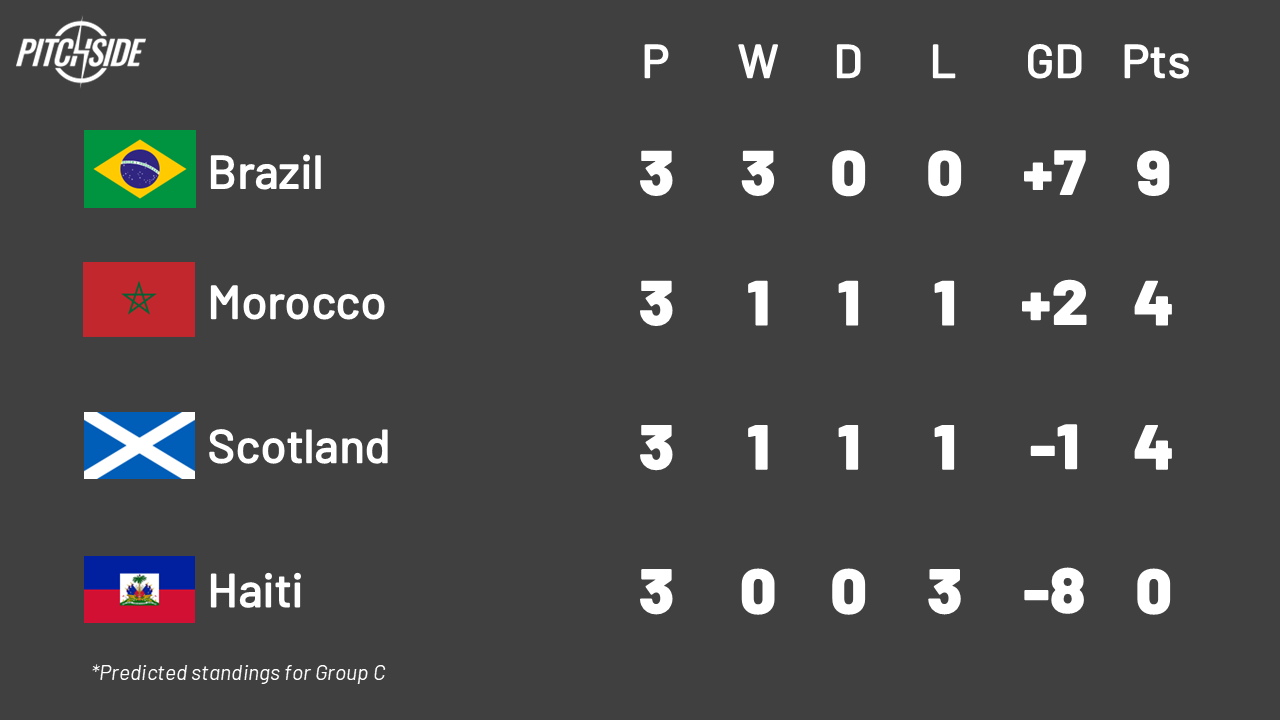
🥇 1st Place Prediction: Brazil
Ancelotti brings the tactical calm and man-management Brazil have needed for years. Vinicius, Raphinha, and Guimaraes are elite. A draw against Morocco in a tight opening match, followed by comfortable wins over Haiti and a vulnerable Scotland side, gives Brazil the group. Their issue will not be the group stage. It will be what comes after.
🥈 2nd Place Prediction: Morocco
Morocco will not concede easily, even to Brazil. Their defensive discipline is tournament-tested and their counter-attacking threat through Hakimi and Diaz is real. They will finish second, win comfortably against Haiti, and give Scotland very little. Ouahbi's youth revolution may take a match or two to settle, but the talent is there.
4. THE THIRD-PLACE QUESTION
As noted across Days 1 and 2 of this series, 8 of 12 third-place teams advance at the 2026 World Cup, giving Group C's third-place team a baseline 66.7% chance of progression.
Scotland's third-place scenario depends entirely on points and goal difference. Against Brazil and Morocco, they are likely to concede. The target is to win the Haiti opener convincingly and keep the score tight against both Brazil and Morocco. A third-place finish with 3 points and a goal difference of -1 or better gives Scotland a strong chance of advancing.
The complicating factor for Scotland is that Group C contains two top-10 sides. Third-place teams from groups with Brazil and Morocco as the top two are likely to have a harder time posting a flattering goal difference than third-place teams from lighter groups. Scotland's best path to the Round of 32 as a third-place team: beat Haiti by 2 or more, hold Morocco to a 1-goal margin, and force something against Brazil. Achievable? Just about.
This is also Group C's unique drama: with Scotland making their first World Cup since 1998, and Haiti their first since 1974, the third-place race within this group carries 52 combined years of footballing longing.
5. FINAL VERDICT
Brazil are the best team on paper at this World Cup, and Group C is the stage where Ancelotti's men announce themselves. The opener against Morocco at MetLife will be close, possibly ending in a draw that sets the group alight, before Brazil find their groove in Matchdays 2 and 3. Vinicius and Raphinha are the most dangerous wide partnership in the tournament. If the central striker question gets resolved quickly, Brazil are a genuine title threat.
Morocco are a team in transition but a very talented one. Hakimi, Diaz, Amrabat, Bounou, and the core of the 2022 side are still here and still excellent. Ouahbi's lack of top-level coaching experience is the one variable no one can fully predict. If he finds the right balance quickly, Morocco could finish first. If the new players take time to click, second is still likely but the margin will be tight.
Scotland's story is the emotional pull of Group C. McTominay has never been better. Robertson has never wanted a World Cup more. This Scotland side qualified for the first time since 1998 by playing direct, disciplined, and committed football under a manager who has built a genuine team rather than a collection of individuals. They will make Brazil and Morocco work hard. They may not get through. But no one will be able to say they did not try.
Haiti are the group's heart. Every player in that squad came from somewhere else: France, England, the United States, Canada. Many have never set foot in Haiti. But they qualified together, under difficult conditions, and they will play together at a World Cup for the first time in 52 years. Football being football, do not entirely rule out something happening against Scotland on June 13 in Boston.
Tomorrow: Group D - United States, Paraguay, Australia, and Turkey.
The last co-host makes its entrance.

Hamza Ahmed
Content & Analytics