2026 World Cup: Group Stage Deep Dive - Day 2 of 12
- World Cup
- Group B
- Switzerland
- Canada
- Bosnia and Herzegovina
- Qatar
Group B | June 12–24, 2026 | Toronto · Santa Clara · Los Angeles · Vancouver · Seattle
Teams: 🇨🇦 Canada (FIFA #27) · 🇧🇦 Bosnia and Herzegovina (FIFA #71) · 🇶🇦 Qatar (FIFA #51) · 🇨🇭 Switzerland (FIFA #17)
If Group A was about emotional weight, Group B is about audacity. Canada host their first-ever World Cup at home - a nation still pinching itself that this moment has arrived. Bosnia and Herzegovina beat Italy on penalties to get here, eliminating the four-time world champions in the process. Qatar arrive as two-time defending Asian champions but the worst-prepared team in the field, their planned March friendlies against Argentina and Serbia cancelled entirely due to regional conflict. And Switzerland - the quiet professionals - have knocked out France, Spain, and Italy in recent knockout rounds and arrived in North America as the group's most technically complete side.
This is a group where the narratives are as compelling as the football. A co-host chasing history, a nation that shocked the world just to get here, an Asian power trying to erase the shame of 2022, and a Swiss machine that refuses to overachieve or underachieve.
1. MATCH SCHEDULE
Fri 12 Jun, 3:00 PM ET: 🇨🇦 Canada vs Bosnia and Herzegovina 🇧🇦
BMO Field, Toronto
Sat 13 Jun, 3:00 PM ET: 🇶🇦 Qatar vs Switzerland 🇨🇭
Levi's Stadium, Santa Clara
Thu 18 Jun, 3:00 PM ET: 🇨🇭 Switzerland vs Bosnia and Herzegovina 🇧🇦
SoFi Stadium, Inglewood
Thu 18 Jun, 6:00 PM ET: 🇨🇦 Canada vs Qatar 🇶🇦
BC Place, Vancouver
Wed 24 Jun, 3:00 PM ET: 🇨🇭 Switzerland vs Canada 🇨🇦
BC Place, Vancouver
Wed 24 Jun, 3:00 PM ET: 🇧🇦 Bosnia and Herzegovina vs Qatar 🇶🇦
Lumen Field, Seattle
2. TEAM PROFILES
🇨🇦 CANADA - Les Rouges
Co-host | CONCACAF | FIFA Rank #27 | 3rd World Cup appearance
Key Players: Jonathan David (FWD, Juventus) · Alphonso Davies (LB, Bayern Munich) · Stephen Eustaquio (MID, Porto) · Ismaël Koné (MID, Sassuolo) · Tajon Buchanan (FWD)
Strengths:
Jonathan David is one of the most lethal strikers in Europe - a guaranteed starter who should play every minute
BMO Field in Toronto and BC Place in Vancouver provide a genuine home advantage in two of three group games
Midfield depth is exceptional: Eustaquio, Koné, and Buchanan offer tactical flexibility and high pressing intensity
Rapid rise as a footballing nation - back-to-back CONCACAF Nations League contenders under Jesse Marsch
Physical, fast, and athletically superior to Qatar and Bosnia in most areas of the pitch
Weaknesses:
Alphonso Davies is likely to miss the opening match against Bosnia due to a hamstring injury, a massive blow at the worst possible time
Centre-back chemistry is not fully settled and can be exposed by direct, physical forwards like Dzeko
A true No. 10 is missing - the team can lack creativity in the final third when David is isolated
Pressure of hosting can create anxiety - Canada are a young footballing nation at their first home tournament
Conceded avoidable goals in 2022 qualifying and can be caught cold on the counter against organised defences
Tactics & Identity:
Jesse Marsch's Canada press aggressively and play with high intensity, looking to win the ball high and create chances in transition. The fullbacks — Davies on the left when fit — are integral to the attack, overlapping to stretch opponents and deliver crosses. David leads the line as a clinical finisher, supported by wide midfielders who cut inside and combine. Eustaquio is the midfield engine: a genuine two-way player who links defence to attack with passing range and stamina. Without Davies, Canada's left side loses a dimension of pace and quality that no other player in the squad can fully replicate. The home crowd in Toronto for their opener will be electric, but Bosnia will not be an easy first test.
🇧🇦 BOSNIA AND HERZEGOVINA - Zmajevi (The Dragons)
UEFA Path A Winners | FIFA Rank #71 | 2nd World Cup appearance (1st since 2014)
Key Players: Edin Džeko (FWD, Schalke 04) · Ermedin Demirovic (FWD, Stuttgart) · Benjamin Tahirovic (MID, Brøndby) · Sead Kolašinac (DEF) · Esmir Bajraktarević (FWD)
Strengths:
The greatest qualification story of 2026 - beat Wales and Italy in back-to-back penalty shootouts
Edin Džeko at 40 is still producing: he became the oldest scorer in 2. Bundesliga history this season and leads the line with intelligence and aerial power
Demirovic is a genuine Bundesliga-quality forward who does the dirty work Džeko doesn't - one of Europe's more efficient attackers
Physically direct and mentally resilient - this team has proven it can win from behind under maximum pressure
Most dangerous in the first 15 minutes of each half when pressing intensity is at its peak
Weaknesses:
Džeko is 40 years old with a shoulder injury going into the tournament - his fitness and longevity over three matches is a genuine concern
Coach Barbarez had zero senior management experience before taking the job in 2024 - tactical unpredictability cuts both ways
Miralem Pjanić retired in December 2025, removing the creative midfield force Bosnia have relied on for a decade
Never advanced from a World Cup group stage (one previous appearance, 2014)
The team's diaspora profile - eight players from German clubs across three divisions - creates variable quality in the supporting cast
Tactics & Identity:
Barbarez favours a 4-2-3-1 that is physical and direct, designed for quick transitions and counter-attacks rather than patient build-up. Tahirovic and Gigović operate as a double pivot in midfield, protecting the defence while recycling possession quickly. When Bosnia win the ball, the priority is simple: find Bajraktarević's pace on the right wing or feed Demirović in the channel, who then either links with Džeko or runs in behind. Set-pieces are a significant threat - Džeko in the air remains dangerous regardless of age. The tactical approach is still somewhat of an unknown given Barbarez's inexperience, but the mentality this team has shown - coming from behind in both playoff games to win on penalties - is not something you can coach.
"We're two years ahead of schedule." - Sergej Barbarez, after Bosnia knocked out Italy
🇶🇦 QATAR - Al-Annabi (The Maroon)
AFC Fourth Round Group A Winners | FIFA Rank #51 | 2nd World Cup appearance
Key Players: Akram Afif (AMF, Al-Sadd) · Almoez Ali (FWD, Al-Duhail) · Hassan Al-Haydos (MID, Al-Sadd) · Assim Madibo (MID) · Meshaal Barsham (GK, Al-Sadd)
Strengths:
Akram Afif is genuinely world-class - twice Asian Player of the Year, 11 assists in 16 World Cup qualifying matches, 12 league assists at club level this season alone
Two-time defending Asian Cup champions - Qatar are not the wide-eyed 2022 newcomers anymore
Almoez Ali is a proven goal-scorer with over 60 international goals, the highest xG conversion in the squad
Under Lopetegui, the team has adopted a structured 4-2-3-1 with disciplined defensive organisation and compact shape
Group B is, on paper, the most realistic route to the knockouts Qatar could have hoped for
Weaknesses:
Worst-prepared team in the entire tournament - March friendlies against Serbia and Argentina were cancelled, leaving them with a months-long competitive gap
Won only two of Lopetegui's first eleven matches in charge - the system has not clicked
Defensive transitions remain exposed; the backline struggled repeatedly in qualifying
Became the first host nation to lose their World Cup opener and exit without a point in 2022 - the psychological shadow of that tournament still lingers
Almost all players are based in the Qatar Stars League, with vastly inferior competition levels compared to any other team in this group
Tactics & Identity:
Lopetegui has tested multiple formations: 4-2-3-1, 4-3-3, and hybrid shapes - without settling on a consistent identity. The most reliable setup places Afif behind Almoez Ali with Ahmed Fathi and Madibo as a defensive double pivot. Qatar's approach is to stay compact and organised, deny central space, and release the ball quickly to Afif when it is won. Hassan Al-Haydos, still technically gifted at 35, provides experience in midfield. The problem is that the system has not clicked under Lopetegui. Qatar's best football came under previous management structures, and there are real concerns about whether the new coach has had sufficient time - particularly without those March tests against elite opposition - to build the tactical cohesion needed to compete in a physical group.
"All the country is very, very happy - but now the expectations are above the real situation." - Julen Lopetegui
🇨🇭 SWITZERLAND - The Nati
UEFA Group B Winners | FIFA Rank #17 | 13th World Cup (6th consecutive)
Key Players: Granit Xhaka (MID, Sunderland) · Manuel Akanji (DEF, Inter Milan) · Breel Embolo (FWD, Stade Rennais) · Gregor Kobel (GK, Borussia Dortmund) · Dan Ndoye (FWD, Nottingham Forest)
Strengths:
Granit Xhaka: Switzerland's most capped player ever, now in his fourth World Cup, the midfield quarterback who controls tempo, switches play, and sets the competitive tone
Conceded only two goals across six unbeaten qualifying matches - defensive solidity is a hallmark
Manuel Akanji at Inter Milan is one of Europe's best centre-backs, providing composure under pressure and elite distribution
Midfield depth is genuinely impressive: Freuler, Zakaria, Jashari, Sow, and Rieder all compete for minutes
Have knocked out France, Spain, and Italy in recent knockout rounds - no longer just a tough team to beat, but a genuine threat in any match
Weaknesses:
The perennial critique: can Switzerland translate consistent tournament football into a deep run? They have reached the Round of 16 at three consecutive World Cups without going further
Breel Embolo has been injury-prone throughout his career - if he's not fully fit, the attack lacks a physical focal point
Reliant on ageing leaders: Xhaka is 33, Rodríguez is 32, Al-Haydos-level opponents can find the gaps between lines
A 3-4-2-1 system can look adventurous but requires specific discipline from the wing-backs
Once-famed unpredictability in the final third has become somewhat predictable - opponents know Switzerland's attacking patterns well
Tactics & Identity:
Murat Yakin's Switzerland operate in a fluid 3-4-2-1 that functions as a high-organisation possession system. Akanji acts as a defensive quarterback from the back three, distributing and reading danger early. Xhaka and Freuler operate as the double pivot - Xhaka controlling tempo and switching play, Freuler pressing and winning the ball back. Ndoye and Vargas offer pace and directness from wide positions, interchanging with Okafor when required. Embolo is the reference point up front - his physicality, hold-up play, and clever movement into space are essential to the system. Switzerland's greatest asset is collective intelligence: they rarely beat themselves.
3. PREDICTED STANDINGS
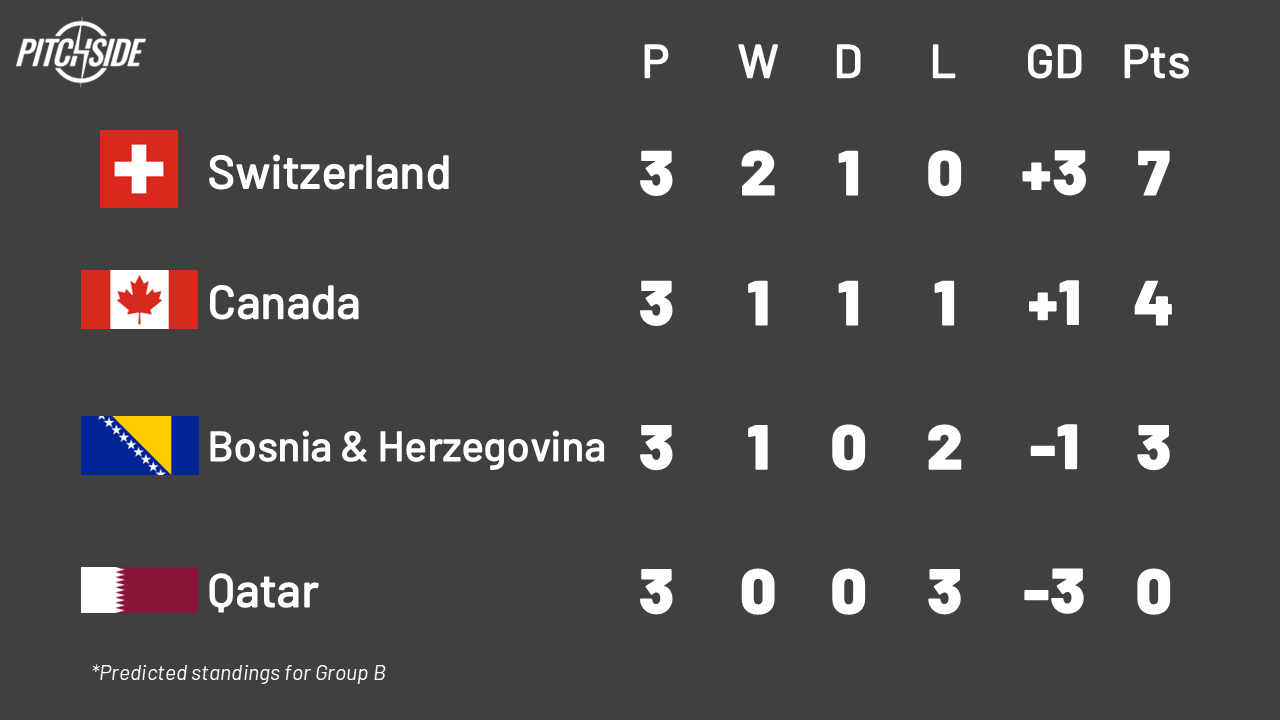
Switzerland's technical quality and experience makes them the clear group favourite. Canada's home advantage and striking power in Jonathan David should be enough for second place, though it will not be comfortable. Bosnia's giant-killing mentality makes the third-place battle genuinely unpredictable. Qatar, underprepared and outgunned in three of four key positions, are the most likely to exit.
🥇 1st Place: Switzerland
The Nati's defensive structure, midfield depth, and Xhaka's experience make them too consistent and too organised for this group. They will not dazzle, but they will not drop points they should not drop. Switzerland win the group playing exactly as they always do - compact, intelligent, and clinical when it matters.
🥈 2nd Place: Canada
Home advantage at BMO Field and BC Place, plus the best individual striker in the group in Jonathan David, gives Canada the edge over Bosnia. The absence of Davies for the opener makes the first match nervy, but Canada's collective depth should carry them through. They finish second - and face a daunting potential knockout match against Group A's winner as a result.
⚠️ The Wildcard: Bosnia and Herzegovina
Bosnia are the most dangerous third-place team in the tournament. If Džeko stays fit, Demirović delivers, and Barbarez's counter-attacking system catches Switzerland or Canada on a bad day, a second-place finish is not impossible. Their fate in third place will likely hinge on goal difference - they will need to beat Qatar convincingly in the final group game.
4. THE THIRD-PLACE QUESTION
As established in yesterday's Group A article, 8 of 12 third-place teams advance to the Round of 32 - giving any group's third-place finisher a baseline 66.7% chance of progression.
Bosnia and Herzegovina's third-place prospects depend heavily on two things: points and goal difference. A three-point third-place finish against Canada and Switzerland - two of the better sides in the tournament - will likely come with a negative goal difference, making their advancement by no means guaranteed. However, Bosnia beating Qatar in the final match (as expected) and keeping it tight in their two losses is a realistic path to a GD of -1 or better with 3 points.
The key comparison: in a group with Canada, Switzerland, and Bosnia, the third-place team's goal difference is likely to be moderate-to-negative, simply because of the quality of the opponents they face. Groups with weaker average quality will produce more flattering records from their third-place sides. Bosnia should cross their fingers and score as many as possible against Qatar.
5. FINAL VERDICT
Group B is Switzerland's to lose, and Switzerland do not lose groups they should win. Xhaka will marshal the midfield, Kobel will command the goal, and Embolo (if healthy) will provide the moments of quality in the final third that separate The Nati from the rest. Expect them through comfortably in first.
Canada's story is the emotional heart of this group. BMO Field in Toronto has never hosted a match of this magnitude. Jonathan David has never played in a tournament of this scale for his country. The absence of Davies for Game 1 is the tournament's first major injury subplot - if Canada drop points against Bosnia without him, the pressure on Game 2 against Qatar becomes enormous. But the talent and the home crowd should ultimately prevail. Les Rouges advance in second.
Bosnia are the group's romance. They beat Italy on penalties to be here. They have a 40-year-old captain playing in the second division of German football who is still scoring goals and still inspiring a nation. They will run teams ragged for 15 minutes at the start of each half, and at least one side in this group will regret not taking them seriously. Džeko's shoulder, Barbarez's inexperience, and the absence of Pjanić are the cracks - but this is a team that has learned to win when wounded.
Qatar are the group's great unknown. Lopetegui is a world-class coach who has not yet found the right key to unlock this squad. Afif is a brilliant player who has never been tested at this level. The preparation gap - no meaningful competitive matches since December 2025 - is a problem that no amount of training camp work can fully solve. They need Afif to produce something special, and they need the defensive structure to hold long enough for him to do it.
Tomorrow: Group C - Brazil, Morocco, Haiti, and Scotland.
The five-time world champions begin their campaign.

Hamza Ahmed
Content & Analytics