2026 World Cup: Group Stage Deep Dive - Day 6 of 12
- World Cup
- Group F
- Tunisia
- Sweden
- Japan
- Netherlands
Group F | June 14–25, 2026 | Houston · Arlington · Monterrey · Kansas City
Teams: 🇳🇱 Netherlands (FIFA #5) · 🇯🇵 Japan (FIFA #18) · 🇸🇪 Sweden (FIFA #24) · 🇹🇳 Tunisia (FIFA #34)
Group F is being called the most balanced group in the tournament, and that label is more than marketing - all four teams arrive with genuine conviction that they belong here and genuine reasons to believe they can advance. The Netherlands are the headline act, carrying three World Cup final appearances and zero trophies into a tournament many believe is their last realistic chance with this generation of players. Japan arrive having beaten Germany, Spain, England and Brazil in recent years and are no longer a team anyone underestimates. Sweden barely survived qualifying - their appointment of Graham Potter proved transformative, and Viktor Gyökeres secured their place with a hat-trick against Ukraine and an 88th-minute winner against Poland. Tunisia arrive as the only African nation to have appeared at five or more World Cups without ever advancing from the group stage, carrying that burden and the discipline to potentially shake it off.
This is also the group of transitions. Fifteen of the Netherlands' 26 players are based in the Premier League, the most English-heavy Dutch squad in history. Japan have lost Kaoru Mitoma to injury, stripping their most dynamic wide threat. Sweden have a new coach with less than a year of experience. And Tunisia have changed their entire approach under a coach who is demanding more going forward.
1. MATCH SCHEDULE
Sun 14 Jun, 4:00 PM ET: 🇳🇱 Netherlands vs Japan 🇯🇵
AT&T Stadium, Arlington, TX
Sun 14 Jun, 10:00 PM ET: 🇸🇪 Sweden vs Tunisia 🇹🇳
Estadio BBVA, Monterrey, Mexico
Sat 20 Jun, 1:00 PM ET: 🇳🇱 Netherlands vs Sweden 🇸🇪
NRG Stadium, Houston, TX
Sat 21 Jun, 12:00 AM ET: 🇹🇳 Tunisia vs Japan 🇯🇵
Estadio BBVA, Monterrey, Mexico
Thu 25 Jun, 7:00 PM ET: 🇹🇳 Tunisia vs Netherlands 🇳🇱
Arrowhead Stadium, Kansas City, MO
Thu 25 Jun, 10:00 PM ET: 🇯🇵 Japan vs Sweden 🇸🇪
AT&T Stadium, Arlington, TX
2. TEAM PROFILES
🇳🇱 NETHERLANDS - Oranje
UEFA Group D Winners | FIFA Rank #5 | 12th World Cup | 3x runners-up
Key Players: Virgil van Dijk (CB/Captain, Liverpool) · Frenkie de Jong (MID, Barcelona) · Tijjani Reijnders (MID, Manchester City) · Ryan Gravenberch (MID, Liverpool) · Nathan Aké (DEF, Manchester City) · Cody Gakpo (FWD, Liverpool) · Memphis Depay (FWD)
Strengths:
Virgil van Dijk remains one of the best centre-backs in the world and provides the defensive anchor and leadership around which everything is built
Seven players based at Barcelona, Manchester City, Arsenal, and Liverpool - 15 of 26 in the Premier League - reflects the depth and quality distributed across every position
Won their qualifying group without a single defeat, scoring 27 goals and conceding just four
Reijnders at Manchester City had a breakout Premier League season and provides the creative midfield energy the squad needed to complement de Jong's control
Ronald Koeman has settled on a pragmatic 4-3-3 built on collective organisation rather than individual flair - a system that has proven sustainable over a long campaign
Weaknesses:
Three World Cup final appearances, no trophies - the psychological weight of being the best team to never win is a real variable when knockout football arrives
Key absences: Xavi Simons and Matthijs de Ligt are both out through injury, and Jeremie Frimpong was not selected, removing pace and creativity from multiple positions
The front three lacks the kind of reliable 20-goal striker that elite tournament sides typically carry - Netherlands' attack is collective rather than anchored by a prolific individual finisher
Koeman's position is set to be reviewed after this tournament, adding a pressure dynamic that players are aware of
March friendlies - a 2-1 win over Norway and a 1-1 draw with Ecuador - produced individual errors that reminded observers of Dutch defensive fragility in transition
Tactics & Identity:
Koeman's Netherlands operate in a pragmatic 4-3-3 that prioritises defensive compactness and efficient transitions over the "Total Football" romanticism that follows the Dutch identity. Van Dijk commands the defensive line, Gravenberch and Reijnders provide mobility and pressing intensity in midfield, and de Jong controls possession and switches play with his trademark composure. The front three - Gakpo and two rotating wide forwards - are expected to create and score. The system is functional and hard to break down, but Koeman's critics argue it lacks the creative ambition that has historically defined Dutch football at its best.
🇯🇵 JAPAN - Samurai Blue
AFC Group C Winners | FIFA Rank #18 | 8th consecutive World Cup
Key Players: Takefusa Kubo (AMF, Real Sociedad) · Daichi Kamada (MID, Crystal Palace) · Ritsu Doan (FWD, Freiburg) · Hidemasa Morita (MID) · Ko Itakura (DEF, Borussia Mönchengladbach)
Strengths:
Beat England 1-0 at Wembley in March 2026, becoming the first Asian nation ever to defeat the Three Lions on home soil - a result that rewired how the football world sees this squad
Recent results against elite opposition are extraordinary: wins over Germany, Spain, England, and Brazil in the past four years
Kubo at Real Sociedad provides elite creativity and goalscoring threat from a playmaking position - he is now the squad's most dangerous attacker following Mitoma's injury
Disciplined defensive structure under Moriyasu - Japan do not get beaten often, and they make teams work very hard to break them down
Collective system and pressing intensity are among the most sophisticated of any team in the tournament - technically, Japan are no longer a surprise, they are a benchmark
Weaknesses:
Kaoru Mitoma is out of the squad through injury - his absence removes the most direct and explosive attacking outlet Japan had, and no other player in the squad offers the same combination of pace and end product from wide positions
The striker position lacks a player who regularly scores at the highest club level - Japan's goals tend to come from midfield runners and wide players rather than from a recognised centre-forward
Moriyasu's 4-3-3 can become too compact and deep-defending when the squad loses confidence, which reduces the ability to chase games when behind
The Netherlands opener is the group's hardest first fixture, and any early stumble against van Dijk's defence could create anxiety in a squad that performs best with belief
Tactics & Identity:
Hajime Moriyasu has drilled Japan in a structured, high-pressing 4-3-3 that relies on collective discipline, compact defensive blocks, and rapid transitions. Without Mitoma, Kubo carries the primary creative burden. Kamada at Crystal Palace provides the tactical intelligence to connect midfield to attack. Japan press high in organised lines, force turnovers in dangerous areas, and transition at pace - a style that has caused significant problems for teams that expect to control the ball against them.
🇸🇪 SWEDEN - Blågult
UEFA Playoff Path B Winners | FIFA Rank #24 | 13th World Cup (first since 2018)
Key Players: Viktor Gyökeres (FWD, Arsenal) · Dejan Kulusevski (MID/FWD, Tottenham) · Alexander Isak (FWD, Newcastle United) · Emil Krafth (DEF) · Robin Quaison (MID)
Strengths:
Viktor Gyökeres was one of the most prolific strikers in European football in 2025-26, arriving at Arsenal after a staggering Sporting CP season - a hat-trick against Ukraine and the qualifying-sealing winner against Poland made him the face of Sweden's qualification
The Gyökeres-Isak partnership is arguably the most dangerous striker pairing at this tournament - two players from Europe's top clubs who are both capable of winning a match individually
Graham Potter transformed the squad after a dismal start to qualifying that included heavy defeats - under him, Sweden finished the playoff campaign with purpose, structure, and collective belief
Kulusevski at Tottenham provides creative width and the ability to both score and create from the right flank
Sweden are physically formidable and extremely difficult to beat in direct duels - their intensity and commitment over 90 minutes is a weapon in any group-stage match
Weaknesses:
Graham Potter has been in the job for less than a year - the tactical system and squad chemistry are still solidifying, and a manager with limited tournament experience at the international level is a genuine variable in high-pressure moments
Sweden barely qualified - their path through the playoffs was narrow and came down to individual brilliance rather than collective dominance
The squad beyond the two strikers is not elite - if Gyökeres and Isak are both subdued in the same match, Sweden's attack lacks a third option of comparable quality
The Japan and Netherlands matches are both extremely demanding - Sweden could very realistically end up in a three-way battle for second place that goes to the final matchday
Tactics & Identity:
Potter favours a 4-3-3 that utilises the pace of the front three while maintaining a structured and disciplined midfield block. Gyökeres leads the line as a physical, pressing, and relentlessly goalscoring striker. Isak and Kulusevski rotate in wide positions, combining runs in behind with cut-inside deliveries. The midfield provides energy rather than creativity - Sweden's ball movement is direct, built on releasing the forwards into space rather than building possession patiently.
🇹🇳 TUNISIA - Eagles of Carthage
CAF Group G Winners | FIFA Rank #34 | 7th World Cup | Never advanced from group stage
Key Players: Hannibal Mejbri (MID, Burnley) · Ellyes Skhiri (MID, Eintracht Frankfurt) · Yassine Meriah (DEF) · Dylan Bronn (DEF) · Elias Achouri (MID) · Issam Jebali (FWD)
Strengths:
Tunisia conceded just five goals across their entire CAF qualifying campaign - their defensive discipline is among the most rigorously maintained of any team in the tournament
Hannibal Mejbri at Burnley is the squad's most technically gifted player at just 23 - his Premier League experience, vision, and ability to unlock defences provides creative quality no other Tunisian player can match
Skhiri at Frankfurt is a Premier League and Bundesliga-experienced midfielder who provides the defensive anchor and pressing intensity Tunisia build everything around
Organised, compact, and tactically intelligent - Tunisia under their new coach have added attacking intent to the defensive foundation that has always been their identity
The Sweden match on June 14 is Tunisia's most realistic opportunity for points - a team they match physically and tactically
Weaknesses:
The most notorious stat in this group: five World Cup appearances and zero group-stage advances - that record weighs on every tournament appearance, regardless of squad changes
Goalscoring threat beyond Jebali is the most persistent concern - if Tunisia keep clean sheets but cannot score, they cannot advance
The Netherlands and Japan represent a significant step up from any qualifying opponent faced in CAF - their defensive system will face far more creative pressure than it has been tested against
The squad's age profile outside Hannibal is experienced but not explosive - Tunisia are not a team built to chase games from behind
Set-piece delivery is important but if it remains the primary goalscoring route, opponents will prepare specifically to neutralise it
Tactics & Identity:
Tunisia set up in a 4-3-2-1 or 4-5-1 depending on the opponent, with the emphasis always on defensive compactness and maintaining shape. Skhiri anchors the midfield, Hannibal operates with freedom in a No. 10 role or wide, and the wingers track back to form a deep, narrow block. Tunisia's counter-attacking structure is built on pace down the flanks and Jebali's movement in behind. Their best football comes when they can absorb pressure for extended periods, force a mistake, and punish quickly - a formula that has worked well in CAF qualifying but will be tested more severely here.
3. PREDICTED STANDINGS
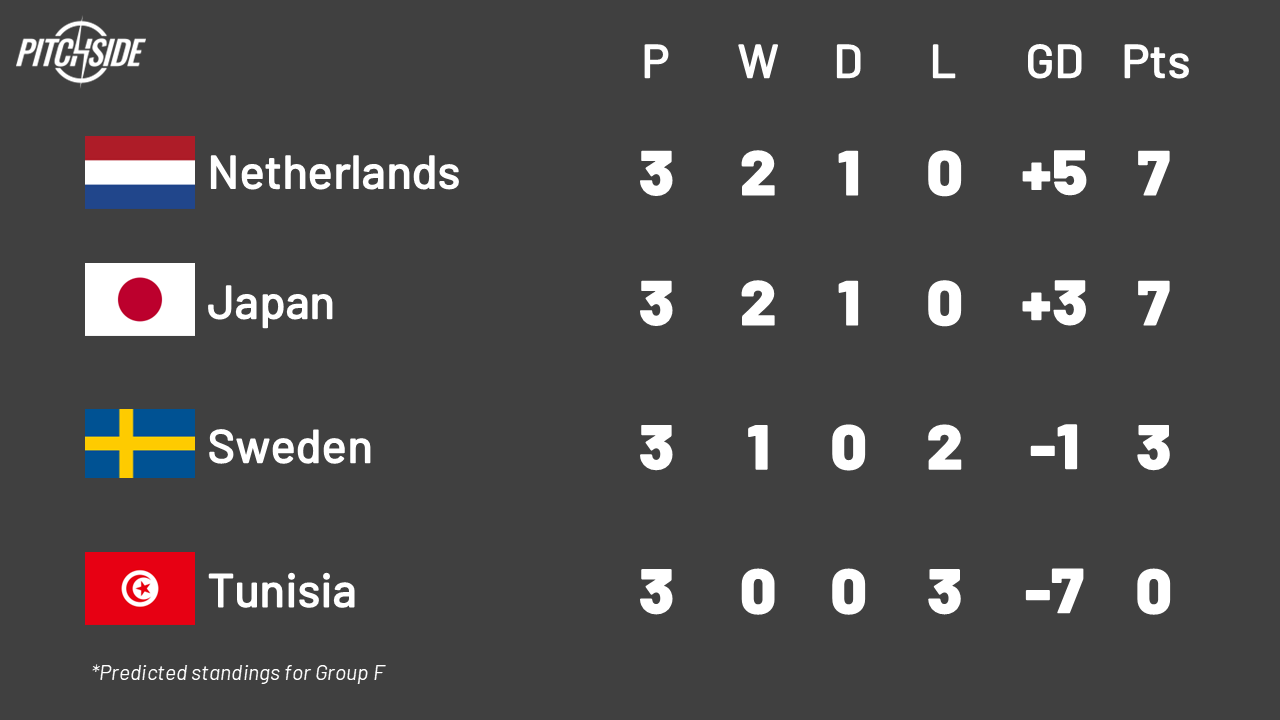
Netherlands and Japan are the two best teams in this group and the most likely qualifiers. The question of first vs. second will probably come down to their Matchday 1 head-to-head in Arlington. Sweden's two elite strikers give them a genuine claim on upsetting that order. Tunisia are the group's most defensively organised side but lack the attacking quality to produce results against three teams with higher individual quality.
🥇 1st Place: Netherlands
The Netherlands draw Japan in the group's defining opener - a result that reflects Japan's quality rather than Dutch weakness. Two further wins over Sweden and Tunisia, combined with a slightly better goal difference, gives the Dutch first place on 7 points. The knockout rounds will determine whether this generation has finally found what it has been looking for.
🥈 2nd Place: Japan
Kubo assumes Mitoma's creative mantle, Kamada provides the intelligence, and Japan earn a hard-fought draw with the Netherlands on Matchday 1 - a statement result. Wins over Sweden and Tunisia follow, and Japan advance in second on equal points with the Dutch, separated only by goal difference. They carry genuine ambitions into the knockout stage for the first time since 2022.
⚠️ The Wildcard: Sweden
Gyökeres and Isak together are the group's most dangerous striking partnership. If they fire in the same match - particularly against Tunisia or Japan - Sweden can take second. Their late qualifying drama suggests a team that finds a way when it matters.
4. THE THIRD-PLACE QUESTION
Sweden's third-place scenario is relatively favourable. A team with two world-class strikers and a disciplined defensive structure should be able to manage their goal difference effectively against all three opponents. A three-point third-place finish with a neutral or positive goal difference gives Sweden a strong chance of advancing as one of the eight best third-place sides.
The key match for Sweden's third-place GD: the Tunisia fixture. A comfortable win there - very achievable given the attacking quality - sets the platform for a positive goal difference that makes third-place progression likely.
5. FINAL VERDICT
Group F is the tournament's most watchable group from a tactical standpoint. Four teams with genuinely different styles, playing each other across three weeks in some of the tournament's best atmospheres.
Netherlands carry the weight of three finals without a winner's medal and a generation of players who are running out of time. Van Dijk at 34, de Jong as the conductor, and a Premier League-heavy squad that knows how to win in difficult conditions. If they can find a clinical striker - or if the collective goals from midfield runners accumulate - they go deep in this tournament.
Japan are no longer a team that anyone takes lightly. Beating England at Wembley is a statement that transcends the result - it says this squad believes it can beat anyone, anywhere. Without Mitoma they are less explosive, but Kubo is world-class and Moriyasu's system produces results against teams that expect easy nights.
Sweden's story begins with a hat-trick against Ukraine and ends - or does not - with Gyökeres and Isak in full flow at a World Cup. Potter has three months to build enough tactical cohesion around those two players to make them impossible to contain. If he succeeds, Sweden could go further than the group stage for the first time since 2006.
Tunisia are here to end a record. Five World Cups, five group-stage exits. Hannibal is the player who could finally make the difference - a 23-year-old who plays week-in week-out in the Premier League and who has the quality to produce something decisive in any of these three matches. The Eagles of Carthage have the defensive organisation. The question, as always, is whether they can score enough goals.
Tomorrow: Group G - Belgium, Egypt, Iran, and New Zealand.

Hamza Ahmed
Content & Analytics